


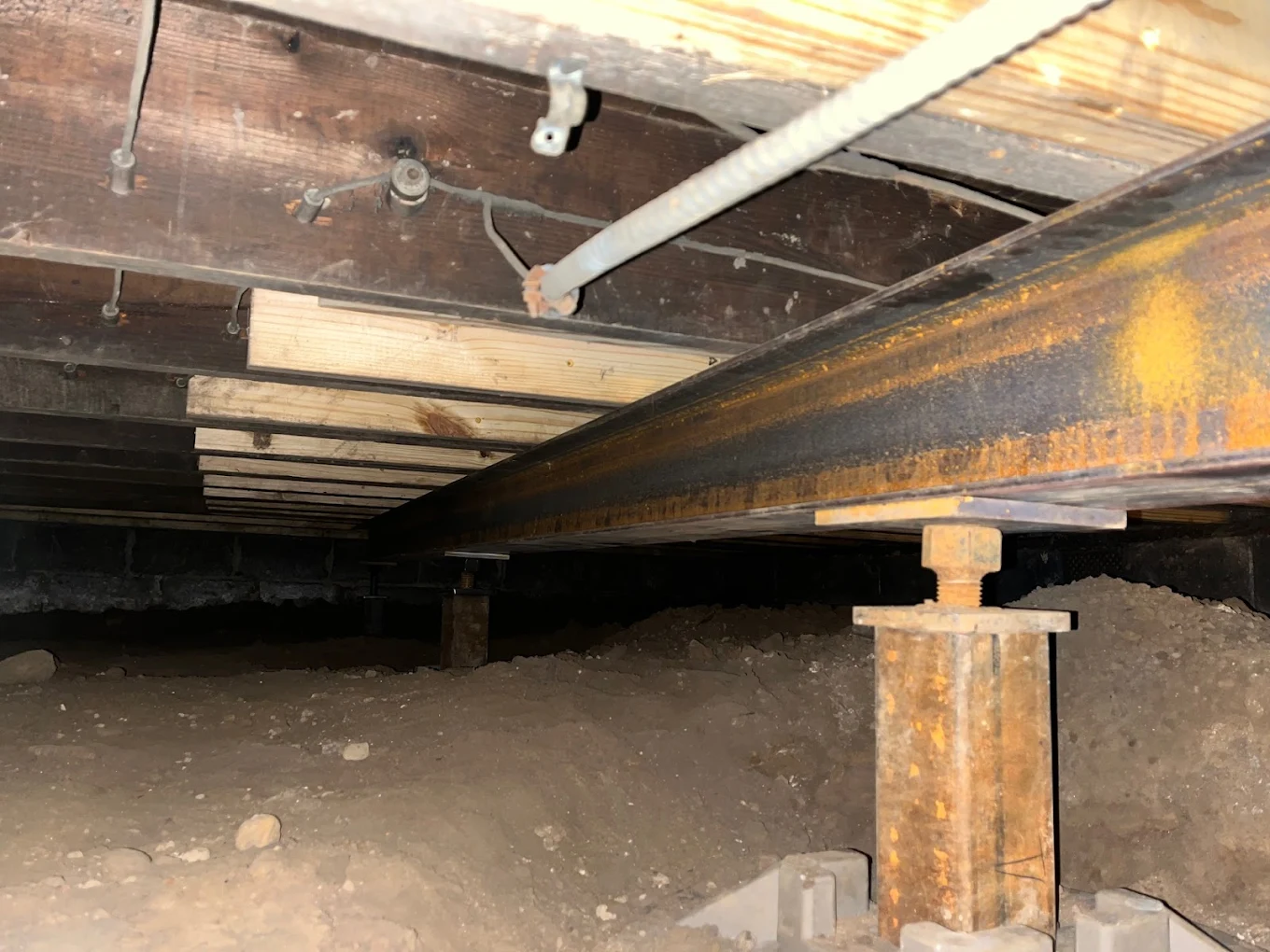
A floor that feels soft, bouncy, sloped, or noticeably uneven can be more than an inconvenience. In homes built over crawl spaces, changes in the floor above may be connected to problems with the joists, beams, supports, or other structural components beneath the home.
Sagging floors do not have one universal cause. Moisture may have weakened the wood. A beam or joist may be damaged. Existing supports may no longer be providing adequate reinforcement. In other situations, settlement or structural movement may have changed how the floor system is supported.
Because several different problems can produce similar symptoms, determining why a floor is sagging is the first step toward choosing an appropriate repair.
Below, we explain some of the most common causes of sagging floors above crawl spaces, the warning signs homeowners may notice, and the types of repairs that may be considered after a professional inspection.
Why Do Floors Sag Over a Crawl Space?
The floor above a crawl space is supported by a structural system that may include floor joists, beams, girders, posts, piers, and foundation components.
When part of that system becomes weakened, damaged, or inadequately supported, the floor above can begin to move.
Sometimes the change happens slowly enough that homeowners do not notice it immediately. In other cases, a soft area, sloping floor, sticking door, or visible dip may make the problem more obvious.
Common causes include the following.
1. Moisture Can Weaken Crawl Space Wood
Persistent moisture is one of the conditions that can contribute to deterioration beneath a home.
Crawl spaces can be exposed to moisture through:
- Ground moisture
- Humid air
- Plumbing leaks
- Water intrusion after storms
- Poor drainage around the foundation
- Condensation
- Other unresolved moisture sources
When wood remains damp for extended periods, its condition may deteriorate. Floor joists, beams, or other framing components may eventually lose some of their ability to provide the support they were intended to provide.
Moisture problems can also create conditions that contribute to other crawl space concerns, making it important to identify both the structural issue and the source of moisture.
Simply strengthening a damaged floor system without addressing an active moisture problem may leave the underlying cause unresolved.
For homeowners dealing with both structural and moisture concerns, Crossroads Foundation Repair’s Crawl Space Repair services can help determine what is happening beneath the home and what type of repair may be appropriate.
2. Wood Rot and Deteriorated Framing
Wood rot can affect the joists, beams, sill plates, and other structural wood components that help support a home’s floor system.
The severity can vary considerably.
A small area of deterioration may affect only one portion of the floor system. More extensive deterioration may involve multiple framing components or support areas.
Homeowners may not see this damage because much of it occurs beneath the floor. Instead, they may first notice symptoms inside the living space.
Those symptoms can include:
- A floor that feels unusually soft
- A visible dip in part of the room
- Increased floor movement
- Changes in the way doors close
- Gaps near walls or trim
A crawl space inspection allows the framing to be evaluated directly rather than attempting to diagnose the problem based only on what is visible upstairs.
3. Damaged or Failing Floor Joists
Floor joists span beneath the flooring and transfer loads to the beams and other supporting components below them.
If a joist becomes damaged or loses structural strength, the floor above may begin to sag or flex.
Potential problems can include:
- Moisture-related deterioration
- Cracking or splitting
- Previous alterations to the framing
- Areas where joists have been compromised
- Long-term stress on an inadequately supported section
The appropriate repair depends on the condition of the joist and the surrounding floor system.
In some situations, damaged framing may be reinforced. In others, additional structural work may be necessary.
This is one reason sagging-floor repairs should be based on an inspection rather than assuming that adding a support post will solve every problem.
4. Beams and Girders May Need Additional Support
Beams and girders help carry loads from the floor joists and transfer them to the supports below.
If one of these components becomes damaged or is no longer adequately supported, a larger portion of the floor can begin to settle or sag.
A homeowner may notice:
- A long dip running through a room
- Multiple rooms with uneven floors
- Flooring that slopes toward the center of the home
- Doors that rub or become difficult to close
- Cracks developing in interior finishes
During an inspection, the condition of the beams and their supports should be evaluated together.
The problem may be the beam itself, the posts beneath it, the footing supporting those posts, or a combination of several conditions.
5. Crawl Space Supports May Be Inadequate or Failing
Posts and other support systems beneath a crawl space help transfer structural loads to the ground or supporting footings.
Problems can occur when supports:
- Shift
- Settle
- Deteriorate
- Lose contact with the beam
- Are improperly spaced
- Were not designed for the load being carried
- Depend on inadequate footings
In these situations, the framing above may gradually move downward as the support system changes.
Additional support may sometimes be part of the repair, but a contractor first needs to determine why the existing support is no longer performing properly.
Adding support without understanding the underlying structural conditions can result in an incomplete repair.
6. Settlement and Structural Movement
Not every sagging-floor problem originates with deteriorated wood.
Movement within the foundation or support system can also affect the floor above.
If part of the structure settles or shifts, the framing connected to that area may move with it. This can create changes in floor elevation even when some of the wood framing remains in relatively good condition.
Possible signs of broader structural movement can include:
- Sloping floors
- Wall or ceiling cracks
- Doors or windows that begin sticking
- Gaps around trim
- Foundation cracks
- Movement in basement or crawl space walls
When those symptoms appear together, the inspection may need to look beyond individual floor joists and consider the overall foundation system.
Learn more about Foundation Repair if your home is showing signs of settlement or structural movement in addition to uneven floors.
Warning Signs of a Crawl Space Floor Problem
Sagging does not always begin as an obvious depression in the middle of a room.
Early symptoms may be relatively subtle.
Watch for signs such as:
Floors That Feel Bouncy
A floor that moves noticeably when someone walks across it may indicate that part of the floor system is flexing more than expected.
Soft Areas in the Floor
If one area feels softer or less stable than the surrounding flooring, the framing beneath that location should be investigated.
Visible Sloping or Dips
Furniture may appear uneven, objects may roll across the floor, or you may visibly notice that one portion of a room is lower than another.
Interior Doors That Stick
Changes in the structure can alter door openings and cause doors to rub, stick, or stop latching correctly.
Gaps Around Walls or Trim
Movement in the floor system can sometimes create gaps where floors, walls, molding, or cabinets meet.
Cracks in Drywall
Drywall cracks can have many causes, but when they appear alongside sagging floors or other structural symptoms, they may justify further investigation.
Musty Odors or High Humidity
Structural symptoms combined with moisture-related symptoms may indicate that crawl space conditions are contributing to deterioration beneath the home.
Are Sagging Floors Always a Foundation Problem?
No.
A sagging floor can be related to the foundation, but it can also result from localized problems with floor joists, beams, supports, or moisture-damaged wood.
That distinction matters because different causes require different repairs.
For example:
- A damaged joist may require framing repair or reinforcement.
- A failing support system may require additional structural support.
- Active moisture may require drainage or moisture-control work.
- Foundation settlement may require a foundation stabilization solution.
- Multiple problems may need to be addressed together.
A professional inspection helps determine which components are involved before a repair plan is developed.
Can Moisture and Structural Problems Occur Together?
Yes.
Crawl space problems frequently overlap.
For example, moisture may contribute to wood deterioration while an inadequate support system allows the weakened framing to move. A crawl space might also have drainage problems, damaged joists, and uneven supports at the same time.
That is why the goal of an inspection should be to evaluate the entire system, not simply the most visible symptom.
Repairing structural damage while leaving serious moisture conditions unresolved may not address the cause. Likewise, installing moisture-control measures does not automatically repair framing that has already been damaged.
If moisture is part of the problem, our guide to Crawl Space Encapsulation vs. Crawl Space Waterproofing explains how those solutions differ.
How Are Sagging Floors Above Crawl Spaces Repaired?
The appropriate repair depends on what the inspection finds.
There is no single sagging-floor repair that is appropriate for every home.
Depending on the conditions, a repair plan may involve one or more of the following categories.
Joist or Framing Repair
Damaged wood framing may require reinforcement, repair, or replacement depending on its condition.
Beam or Girder Repair
A damaged or inadequately supported beam may need structural reinforcement or additional support.
Crawl Space Support Systems
Additional supports may be installed when the floor system requires additional reinforcement.
The type, placement, and foundation beneath those supports should be determined based on the home’s structural conditions.
Moisture Management
If moisture contributed to the problem, the repair plan may also include measures designed to control water or humidity in the crawl space.
Crawl Space Encapsulation
Encapsulation may help create a more controlled crawl space environment where appropriate, but it is not a substitute for repairing damaged structural components.
Foundation Repair
If settlement or other foundation movement is contributing to the floor problem, the repair may need to address the foundation itself.
The important point is that the repair should match the cause.
What Happens During a Professional Crawl Space Inspection?
A professional evaluation should look beyond the visible sag in the floor.
The inspection may include reviewing:
- Floor joists
- Beams and girders
- Existing posts or supports
- Visible wood deterioration
- Moisture conditions
- Signs of water intrusion
- Foundation components
- Floor movement or elevation changes
- Other visible structural symptoms
The inspector can then explain what appears to be causing the problem and recommend an appropriate repair approach.
This is also the point when homeowners can ask questions about:
- Which components are damaged?
- What caused the problem?
- Is the condition still progressing?
- What does the recommended repair address?
- Does moisture also need to be corrected?
- Are there multiple repair options?
- What warranties apply?
- Is financing available?
Understanding the diagnosis is just as important as understanding the repair.
Should You Wait to Repair a Sagging Floor?
Not every uneven floor represents an urgent structural failure, and older homes may have some floor variation that has remained stable for years.
However, new or worsening movement should not be ignored.
Consider scheduling an inspection if:
- A floor has recently begun sagging
- A soft area is getting worse
- The floor feels increasingly bouncy
- Doors or windows have recently started sticking
- New drywall cracks are appearing
- Moisture is present in the crawl space
- Wood beneath the home appears damaged
- Existing crawl space supports appear to have moved
An inspection can help determine whether the condition requires repair and whether the underlying cause is structural, moisture-related, foundation-related, or a combination of issues.
Sagging Floors in Indiana Homes
Indiana homes can be exposed to changing moisture and weather conditions throughout the year.
Crawl spaces may experience periods of elevated humidity, water intrusion, ground moisture, or other conditions that can affect the environment beneath the home. At the same time, older framing, previous repairs, settlement, and support conditions can all influence how a floor system performs.
Because every property is different, homeowners should avoid assuming that a neighbor’s repair will also be appropriate for their home.
Crossroads Foundation Repair evaluates crawl space and structural concerns for homeowners throughout Indiana, including communities such as Lafayette, South Bend, Muncie, Fort Wayne, Carmel, Bloomington, and surrounding areas.
Homeowners near Fort Wayne can also learn more about foundation and crawl space repair in New Haven, IN.
Frequently Asked Questions
What causes floors to sag above a crawl space?
Sagging floors can be caused by several conditions, including moisture-damaged wood, deteriorated joists or beams, inadequate supports, shifting support posts, or broader foundation settlement. An inspection is needed to determine which part of the structure is causing the movement.
Can crawl space moisture cause sagging floors?
Moisture can contribute to deterioration of wood framing beneath the home. If joists, beams, or other structural components lose strength, the floor above may begin to sag, flex, or feel soft. The moisture source and any structural damage should both be evaluated.
Can sagging floors be fixed without replacing the entire floor?
Often, the problem involves the support structure beneath the floor rather than the finished flooring itself. Depending on the cause, repairs may involve joists, beams, supports, moisture management, or foundation stabilization. The appropriate solution depends on an inspection.
Are bouncy floors a sign of crawl space problems?
They can be. Excessive floor movement may be related to joists, beams, supports, deterioration, or other structural conditions beneath the home. Bouncy floors should be evaluated alongside any other symptoms such as moisture, sagging, cracks, or sticking doors.
Will adding crawl space supports fix a sagging floor?
Additional supports may be appropriate in some situations, but they are not a universal solution. The existing framing, beams, supports, footings, moisture conditions, and potential settlement should be evaluated before determining the correct repair.
Does crawl space encapsulation fix sagging floors?
Encapsulation is intended primarily to help control the crawl space environment and moisture. It does not automatically repair damaged joists, beams, supports, or foundation movement. Structural repairs may need to be completed separately or as part of a broader crawl space repair plan.
How do I know whether sagging floors are caused by the foundation?
Foundation-related floor movement may occur alongside other symptoms such as foundation cracks, sticking doors or windows, drywall cracks, or broader areas of sloping floors. A professional inspection can evaluate both the crawl space framing and foundation to determine where the movement originates.
Schedule a Crawl Space Inspection
If your floors are sagging, bouncing, sloping, or beginning to feel different underfoot, the next step is to find out why.
Crossroads Foundation Repair can inspect the crawl space, evaluate the framing and support system, identify visible moisture or structural concerns, and explain the repair options appropriate for your home.
The goal is not to recommend a predetermined system. It is to understand what is causing the movement and develop a solution that addresses the actual problem.
Schedule your inspection with Crossroads Foundation Repair today.
This article was reviewed for accuracy by Steven Kyle Leman, Owner and General Manager of Crossroads Foundation Repair. Steven has 15 years of hands-on experience with foundation repair and waterproofing systems across Indiana homes and holds certification through the National Foundation Repair Association with continuing education each year.